Interferometer Geometries
What you’ll learn:
How to define interferometer geometries using symbolic unitary operators
How to visualize interferometer tree structures
How to compute analytic phase expressions for Mach-Zehnder and simultaneous conjugate interferometers (SCI)
How to plot interferometer arm trajectories
Mach-Zender Interferometer
Define the needed constants, initialize the required unitary operators, and define the interferometer.
[1]:
from mwave import symbolic as msym
import numpy as np
import sympy as sp
from matplotlib import pyplot as plt

# Set up symbols for symbolic computation
m, c, hbar, k, g, gamma, delta, n, T, t_traj = sp.symbols('m c hbar k g gamma delta n T t_traj', real=True)
k_eff = 2*k

# Register constants
msym.set_constants(m=m, c=c, hbar=hbar, t_traj=t_traj)

# Define unitary operators needed for an MZ interferometer
bs = msym.Beamsplitter(0, n, delta, k_eff)
mirror = msym.Mirror(0, n, delta, k_eff)
free = msym.FreeEv(T, gravity=g, gravity_grad=gamma)

# Create interferometer object, perform MZ sequence
ifr = msym.Interferometer()
(bs @ (free @ (mirror @ (free @ (bs @ ifr)))))
[1]:
<mwave.symbolic.Interferometer at 0x10c31c0b0>
Generate and optionally vizualize the directed tree structure representing the interferometer object.
[2]:
# Create a graphviz object of the tree
d_test = ifr.generate_graph()

# Uncomment to display the graph
# d_test.view()
Check for interferance, set the gravity gradient to zero as otherwise the interferometer won’t perfectly close and no interferance will be detected.
[3]:
inodes = ifr.interfere(subs={gamma: 0})
Determine which port each output is in
[4]:
iports, jports, noport = ifr.get_ports({n:'upper', 0: 'lower'})
Check that we don’t have any unexpected ports
[5]:
if len(jports) != 0 or len(noport) != 0:
    print('Unexpected output')
Set interferometer parameters for plotting
[6]:
subs = {m: 1, c: 1, hbar: 1, k: 1, g: 0.3, gamma: 0.001, delta: 4*3, n: 3, T: 5}
Determine the final interferometer time by evaluating the value of t at the end of the interferometer. We can pick a random interferometer port to do this.
[7]:
tfinal = float(iports['upper'][0].t.evalf(subs=subs))
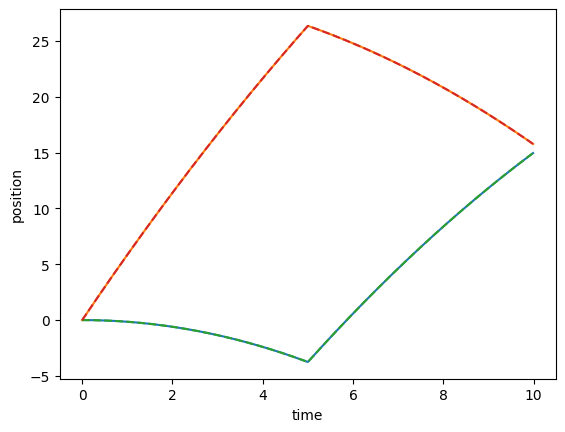
Plot the trajectory of the interferometer paths
[8]:
t = np.linspace(0, tfinal, 1000)
plt.figure()
for node_pair, ls in zip([iports['upper'], iports['lower']], ['-', '--']):
    fnc_traj = node_pair[0].get_trajectory(subs=subs)
    plt.plot(t, fnc_traj(t), linestyle=ls)
    fnc_traj = node_pair[1].get_trajectory(subs=subs)
    plt.plot(t, fnc_traj(t), linestyle=ls)
plt.xlabel('time')
plt.ylabel('position')
plt.show()
Compute the phase of the interferometer
[9]:
# Compute the differential phase
phi1, phi2 = ifr.phases()
print(f'phase_1={sp.simplify(phi1)}')
print(f'phase_2={sp.simplify(phi2)}')

# Print out the total population, check it is equal to 1
pop = 0
for node in ifr.get_nodes():
    pop += (node.get_amp())**2
print(f'total population sum={sp.simplify(pop)}')
phase_1=(-3*T**10*g*gamma**4*k*m*n + 10*T**9*gamma**4*hbar*k**2*n**2 - 34*T**8*g*gamma**3*k*m*n + 56*T**7*gamma**3*hbar*k**2*n**2 - 53*T**6*g*gamma**2*k*m*n + 60*T**5*gamma**2*hbar*k**2*n**2 + 84*T**4*g*gamma*k*m*n - 144*T**3*gamma*hbar*k**2*n**2 + 144*T**2*g*k*m*n - 72*pi*m)/(72*m)
phase_2=T**2*k*n*(-3*T**8*g*gamma**4*m + 10*T**7*gamma**4*hbar*k*n - 34*T**6*g*gamma**3*m + 56*T**5*gamma**3*hbar*k*n - 53*T**4*g*gamma**2*m + 60*T**3*gamma**2*hbar*k*n + 84*T**2*g*gamma*m - 144*T*gamma*hbar*k*n + 144*g*m)/(72*m)
total population sum=1
Simultaneous Conjugate Interferometer
Define the needed constants, initialize the required unitary operators, and define the interferometer.
[1]:
from mwave import symbolic as msym
import numpy as np
import sympy as sp
from matplotlib import pyplot as plt

# Set up symbols for symbolic computation
m, c, hbar, k, omega_r, delta, n, omega_m, T, Tp, t_traj = sp.symbols('m c hbar k omega_r delta n omega_m T Tp t_traj', real=True)
k_eff = 2*k

# Register constants
msym.set_constants(m=m, c=c, hbar=hbar, t_traj=t_traj)

# Define unitary operators needed for an SCI interferometer
bs1 = msym.Beamsplitter(n, 0, delta, k_eff)
bs2 = msym.Beamsplitter(0, -n, delta - omega_m, k_eff)
bs2u = msym.Beamsplitter(n, 2*n, delta + omega_m, k_eff)
fe1 = msym.FreeEv(T)
fe2 = msym.FreeEv(Tp)

# Create interferometer object, perform MZ sequence
ifr = msym.Interferometer()
ifr.apply(bs1)
ifr.apply(fe1)
ifr.apply(bs1)
ifr.apply(fe2)
ifr.apply(bs2)
ifr.apply(bs2u)
ifr.apply(fe1)
ifr.apply(bs2)
ifr.apply(bs2u)
Generate and optionally vizualize the directed tree structure representing the interferometer object.
[2]:
# Create a graphviz object of the tree
d_test = ifr.generate_graph()

# Uncomment to display the graph
# d_test.view()
Check for interferance, set the gravity gradient to zero as otherwise the interferometer won’t perfectly close and no interferance will be detected.
[3]:
inodes = ifr.interfere()
Determine which port each output is in
[4]:
iports, jports, noport = ifr.get_ports({2*n:'A', n:'B', 0:'C', -n:'D'})
Check that we don’t have any unexpected ports
[5]:
if len(jports) != 4 or len(noport) != 0:
    print('Unexpected output')
Set interferometer parameters for plotting
[6]:
subs = {m: 1, c: 1, hbar: 1, k: 1, delta: 4*3, n: 3, T: 5, Tp: 1}
Determine the final interferometer time by evaluating the value of t at the end of the interferometer. We can pick a random interferometer port to do this.
[7]:
tfinal = float(iports['A'][0].t.evalf(subs=subs))
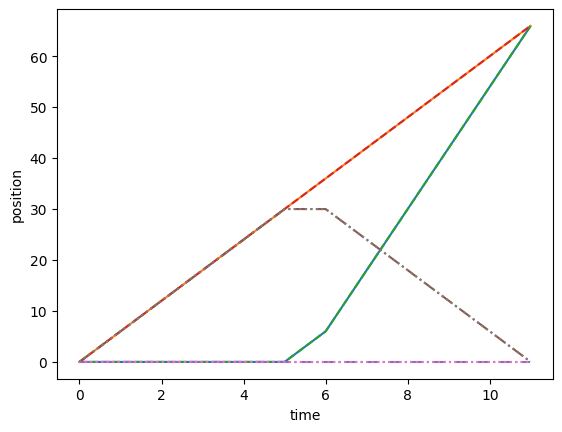
Plot the trajectory of the interferometer paths
[8]:
t = np.linspace(0, tfinal, 1000)
plt.figure()
for port, ls in zip(['A', 'B', 'C', 'D'], ['-', '--', '-.', ':']):
    fnc_traj = iports[port][0].get_trajectory(subs=subs)
    plt.plot(t, fnc_traj(t), linestyle=ls)
    fnc_traj = iports[port][1].get_trajectory(subs=subs)
    plt.plot(t, fnc_traj(t), linestyle=ls)
plt.xlabel('time')
plt.ylabel('position')
plt.show()
Compute the phase of the interferometer
[9]:
# Compute the differential phase
phiA, phiB, phiC, phiD = ifr.phases()
print(f'differential phase={sp.simplify(phiA - phiC).subs(k, sp.sqrt(2*m*omega_r/hbar))}')

# Print out the total population, check it is equal to 1
pop = 0
for node in ifr.get_nodes():
    pop += (node.get_amp())**2
print(f'total population sum={sp.simplify(pop)}')
differential phase=16*T*n**2*omega_r - 2*T*n*omega_m - 2*pi
total population sum=1
Simulatenous Conjugate Interferometer with single Bragg pulses
[1]:
from mwave import symbolic as msym
import numpy as np
import sympy as sp
from matplotlib import pyplot as plt

# Set up symbols for symbolic computation
k, c, hbar, m, g, T_spacing, T, Tp, delta, t_traj, omega_r, omega_0 = sp.symbols('k c hbar m g T_spacing T Tp delta t_traj omega_r omega_0', real=True)
k_eff = 2*k

# Register constants
msym.set_constants(m=m, c=c, hbar=hbar, t_traj=t_traj)
For an n=2 SCI with single Bragg pulses we must run the following pulse sequences for beam splitters
Pulse sequence 1: Split initial state into two, mirror one of the outputs to bragg order n
1       2     ...    n
pi/2 -> pi -> ... -> pi

Pulse sequence 2: Mirror state at momentum n down to 1, then pi/2 to bring to correct state and diffract initially undiffracted arm to 1, then mirror initially undiffracted arm up to n
1            n-1   n       n+1          n+n-1
pi -> ... -> pi -> pi/2 -> pi -> ... -> pi

Pulse sequence 3: pi/2 lower interferometer upper arm down (pi/2 necessary to avoid diffracting away the lower arm), pi pulse to -n. Simulaneously do the same for the upper interferometer lower arm
1       2            n
pi/2 -> pi -> ... -> pi

Pulse sequence 4: pi lower interferometer upper arm up to 0, pi/2 pulse to interfere 0 and -1 states. Simulaneously do the same for the upper interferometer lower arm
1            2     n
pi -> ... -> pi -> pi/2
We will next implement the unitary operators needed to perform these sequences
[2]:
nbragg = 2

bsdict = {}
mdict = {}

# Make function to get/construct a beamsplitter between the two specified states
def get_bs(n0, nf):
    tid = (min(n0,nf), max(n0,nf))
    if tid in bsdict:
        return bsdict[tid]
    else:
        bsdict[tid] = msym.Beamsplitter(min(n0,nf), max(n0,nf), 4*(n0+nf)*omega_0, k_eff)
        return bsdict[tid]

# Make function to get/construct a mirror between the two specified states
def get_m(n0, nf):
    tid = (min(n0,nf), max(n0,nf))
    if tid in mdict:
        return mdict[tid]
    else:
        mdict[tid] = msym.Mirror(min(n0,nf), max(n0,nf), 4*(n0+nf)*omega_0, k_eff)
        return mdict[tid]

# Free evolutions
feTs = msym.FreeEv(T_spacing)
feT = msym.FreeEv(T)
feTp = msym.FreeEv(Tp)

# Beamsplitter sequences
def pulse1(ifr):
    ifr.apply(get_bs(0, 1))
    for n in range(1, nbragg):
        ifr.apply(feTs)
        ifr.apply(get_m(n, n+1))

def pulse2(ifr):
    for n in range(nbragg, 1, -1):
        ifr.apply(get_m(n, n-1))
        ifr.apply(feTs)
    ifr.apply(get_bs(1, 0))
    for n in range(1, nbragg):
        ifr.apply(feTs)
        ifr.apply(get_m(n, n+1))

def pulse3(ifr):
    ifr.apply(get_bs(0, -1))
    ifr.apply(get_bs(nbragg, nbragg+1))
    for n in range(1, nbragg):
        ifr.apply(feTs)
        ifr.apply(get_m(-n, -n-1))
        ifr.apply(get_m(nbragg+n, nbragg+n+1))

def pulse4(ifr):
    for n in range(nbragg, 1, -1):
        ifr.apply(get_m(-n, -n+1))
        ifr.apply(get_m(nbragg+n, nbragg+n-1))
        ifr.apply(feTs)
    ifr.apply(get_bs(0, -1))
    ifr.apply(get_bs(nbragg, nbragg+1))
Create the interferometer object and apply our sequence of unitary operators
[3]:
ifr = msym.Interferometer()
pulse1(ifr)
ifr.apply(feT)
pulse2(ifr)
ifr.apply(feTp)
pulse3(ifr)
ifr.apply(feT)
pulse4(ifr)
Generate and optionally vizualize the directed tree structure representing the interferometer object.
[4]:
# Create a graphviz object of the tree
d_test = ifr.generate_graph()

# Uncomment to display the graph
# d_test.view()
Check for interferance, set the gravity gradient to zero as otherwise the interferometer won’t perfectly close and no interferance will be detected.
[5]:
inodes = ifr.interfere()
Determine which port each output is in
[6]:
iports, jports, noport = ifr.get_ports({nbragg+1:'A', nbragg:'B', 0:'C', -1:'D'})
Check that we don’t have any unexpected ports
[7]:
if len(jports) != 4 or len(noport) != 0:
    print('Unexpected output')
Set interferometer parameters for plotting
[8]:
subs = {k: 2, c: 1, hbar: 1, m: 1, T_spacing: 1, delta: 4*omega_r, omega_r: 1, T:5, Tp: 3, g: 1}
Determine the final interferometer time by evaluating the value of t at the end of the interferometer. We can pick a random interferometer port to do this.
[9]:
tfinal = float(inodes[0][0].t.evalf(subs=subs))
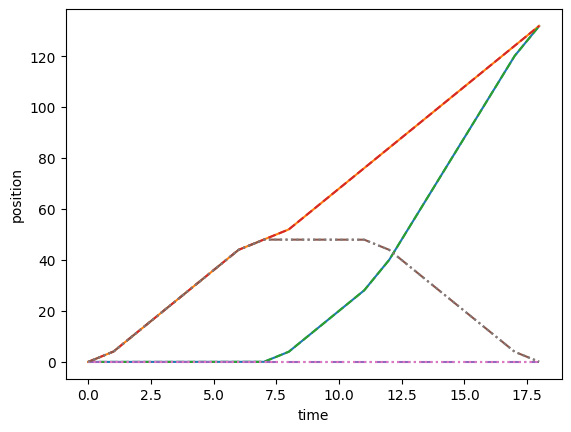
Plot the trajectory of the interferometer paths
[10]:
t = np.linspace(0, tfinal, 1000)
plt.figure()
for port, ls in zip(['A', 'B', 'C', 'D'], ['-', '--', '-.', ':']):
    fnc_traj = iports[port][0].get_trajectory(subs=subs)
    plt.plot(t, fnc_traj(t), linestyle=ls)
    fnc_traj = iports[port][1].get_trajectory(subs=subs)
    plt.plot(t, fnc_traj(t), linestyle=ls)
plt.xlabel('time')
plt.ylabel('position')
plt.show()
Compute the phase of the interferometer
[11]:
# Compute the differential phase
phiA, phiB, phiC, phiD = ifr.phases()
print(f'differential phase={sp.simplify(phiA - phiC).subs(k, sp.sqrt(2*m*omega_r/hbar))}')

# Print out the total population, check it is equal to 1
pop = 0
for node in ifr.get_nodes():
    pop += (node.get_amp())**2
print(f'total population sum={sp.simplify(pop)}')
differential phase=-64*T*omega_0 + 64*T*omega_r - 48*T_spacing*omega_0 + 48*T_spacing*omega_r - 2*pi
total population sum=1